Getting to Know Noh Masks and Noh Theater
Nohgaku (Noh and Kyogen) is often the first thing mentioned as a Japanese classical performing art, but even most Japanese people would say they “don’t know much about it.” This is likely because Nohgaku is perceived as difficult. While Nohgaku consists of Noh and Kyogen, the general impression is that Noh is even more challenging than Kyogen.
Why is Nohgaku So Difficult?
Interest Starts with Knowledge
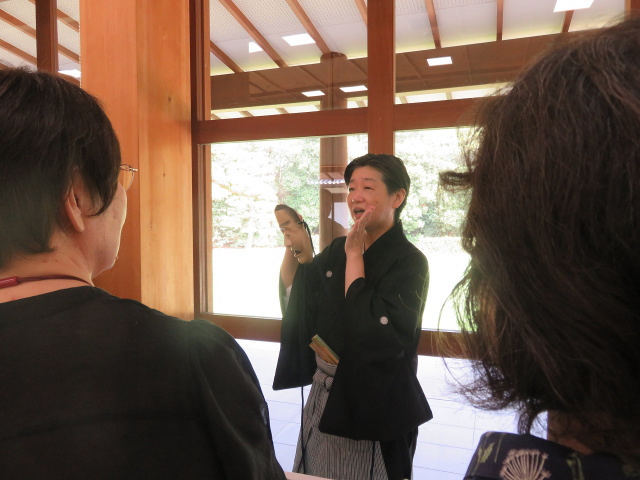
In the past, I participated in a Nohgaku workshop held ahead of the “Takigi Noh” (open-air Noh performed by torchlight) in October 2025. The goal of the workshop was to help people who are unfamiliar with Nohgaku understand and feel closer to it, eventually leading to their attendance at the performance. The session was titled “What is Noh? A Noh Performer Teaches You with Fun!” and the lecturer was Mr. Mito Ishiguro, a Shite-kata (main actor) of the Hosho School.
Additionally, according to an article published in Sankei WEST, another Noh performer, Mr. Bunzo Otsuki (a Shite-kata of the Kanze School and a Living National Treasure), pointed out several reasons for this difficulty:
First, the lyrics (shisho) are hard to understand. This is because they are in classical Japanese and chanted with the specific intonation of Utai (Noh chanting).
Second, the stories lack a clear structure of introduction, development, twist, and conclusion.
Third, it is difficult to understand what the dances during the play signify.https://www.sankei.com/article/20160903-BIKV2WDSAFLI3G5YPWXXUDK3GA/
I cannot say that I fully mastered Nohgaku just by taking that one-hour workshop. However, learning the synopses of the plays and certain traditional rules at that time made me feel that the hurdle to becoming interested in Nohgaku had definitely been lowered.
The Charm of the Omote (Noh Masks)
A Mask Representative of Japan
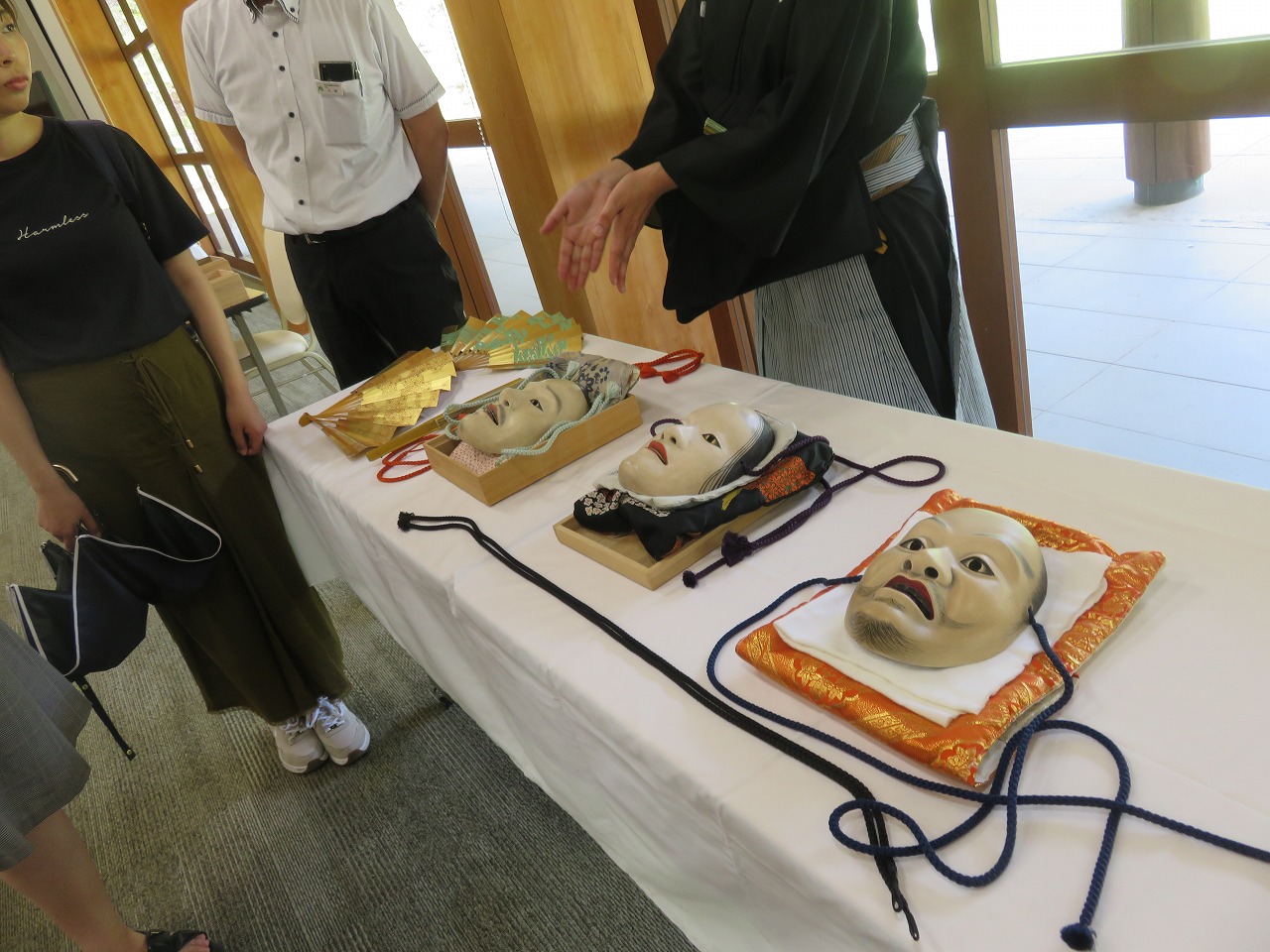
One of the elements that play a crucial role in Nohgaku is the Noh mask, known as “Omote.” While there are various types of masks depending on the role, the most iconic is undoubtedly the “Onna-men” (female mask). It is characterized by its white skin, black hair parted in the center of the forehead, and an oval face. Just by looking at the female mask, I feel a mysterious power that instantly expresses Japan’s sense of mystery and the aesthetic of “Yugen” (a profound, subtle grace and mystery). It is said to represent a transcendental existence that, while having a human-like face, is not human but beyond humanity.
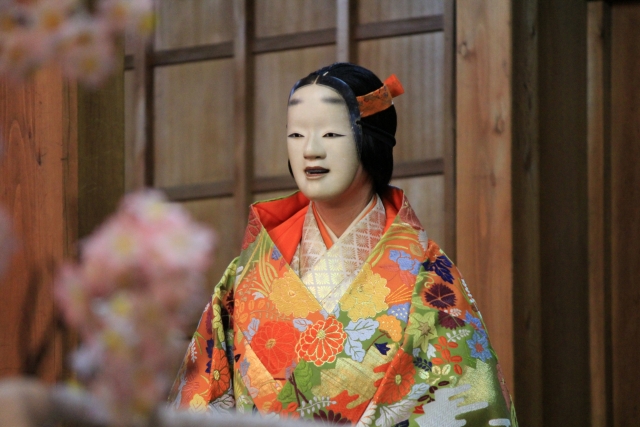
Terasu and Kumurasu
Techniques for Expressing Emotions
At first glance, the female mask may appear expressionless, but by changing its angle during the dance, it expresses emotions of joy and sadness. Tilting the mask slightly upward is called “Terasu” (shining), used when the heart is bright, such as with joy. On the other hand, tilting it slightly downward is called “Kumurasu” (clouding), used to suppress feelings like sadness.
I took photos of the female mask shown to us from three directions: downward, front, and upward. Although the actual angles used in a performance may differ, I wonder if this is close to the image of “Terasu” and “Kumurasu.”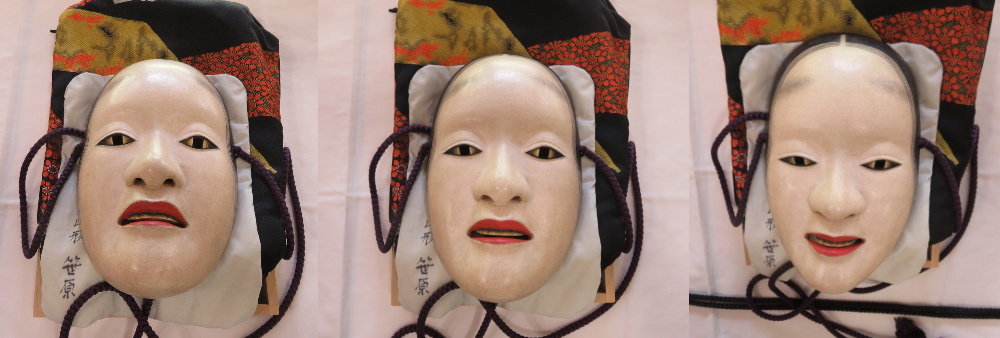
The expression certainly changes significantly. In “Terasu,” the chin looks fuller, the eyes appear larger, and the face looks almost triumphant. In contrast, in “Kumurasu,” the downward tilt makes the face look thinner and carries a sense of sorrow. By the way, this particular mask is said to be the work of someone who makes Noh masks as a hobby. That is why we, the students, were allowed to see it from such a close distance.
Even so, it must be a mask that is actually used, so I perceived Mr. Ishiguro as a generous person with a strong passion for spreading the art of Nohgaku.
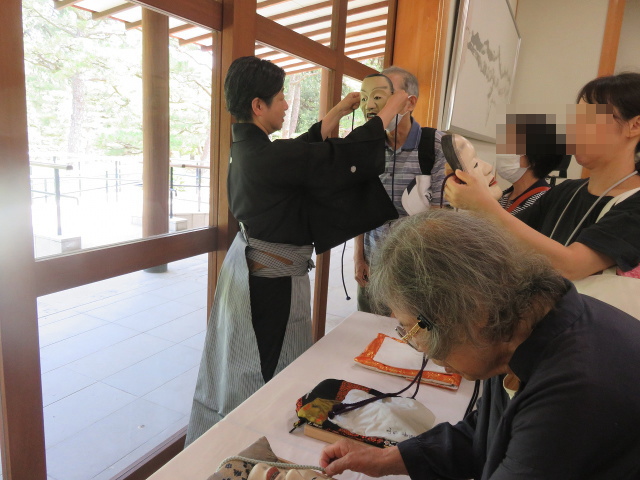
Men-himo (The Mask Strings)
The Colors of Men-himo Vary by Role and School
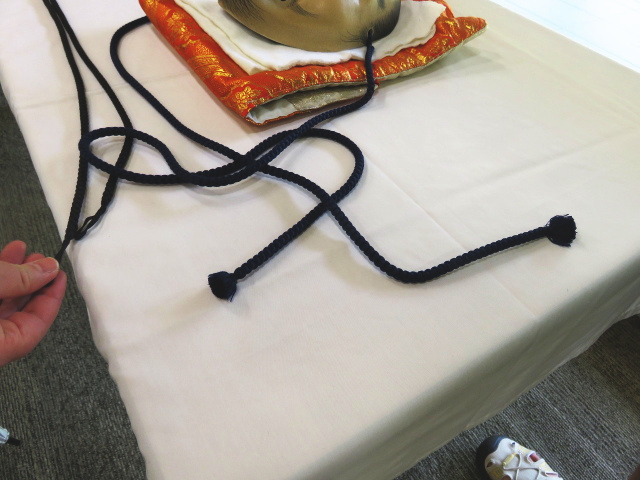
The strings used to attach the mask to the face are called “Men-himo.” They are round-woven as a whole, with only the tip being flat-woven. The color of the Men-himo differs depending on the type of mask. Some parts of the coloring also seem to vary depending on the “Ryuha” (traditional school or style). For instance, in the Hosho School, they use purple for female masks and black for “strong” masks (such as those for demons or powerful characters).
Inside the Mask
Careful Handling of the Mask
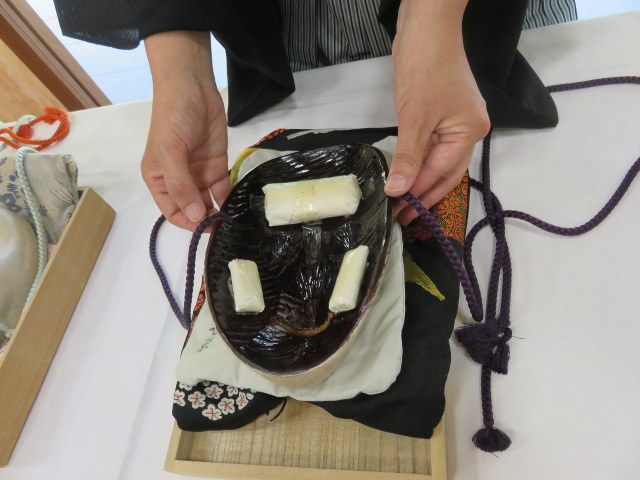
The inside of the mask is coated with lacquer, and “Ate” (padding made of paper or cloth) are attached so that the mask remains stable when worn. These paddings are said to be replaced with new ones for every performance.
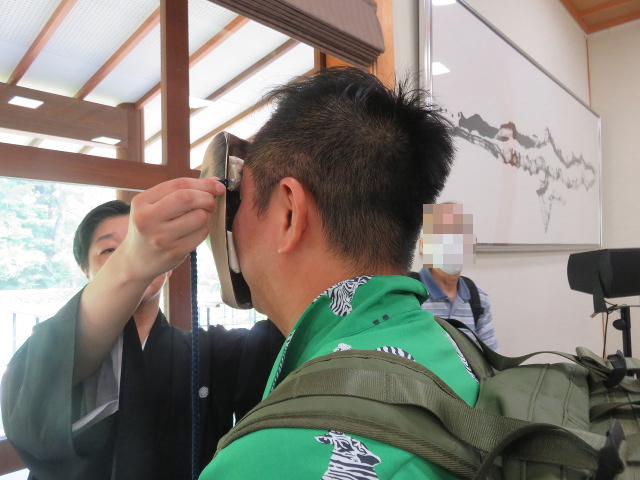
Extreme care is taken to prevent the mask from deteriorating. When attaching the mask, you must pinch the area near the Men-himo holes and avoid touching any other part of the mask.
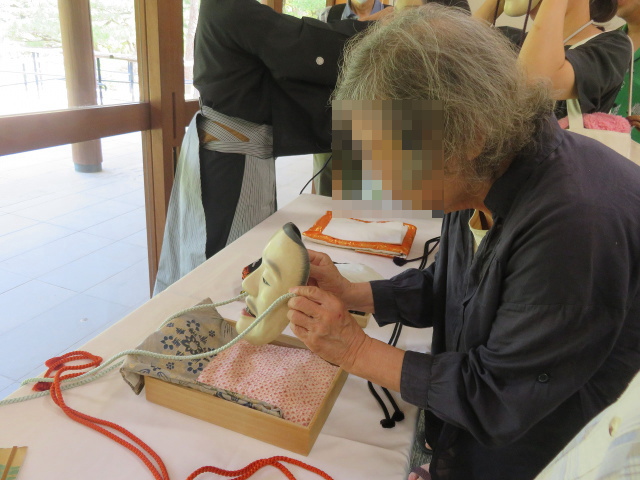
When removing the mask, it is said that they take it off by immediately facing the inside downward to prevent sweat from flowing into the interior of the mask.
Two Male Masks
In addition to the female mask, he also showed us two types of male masks.
Heita
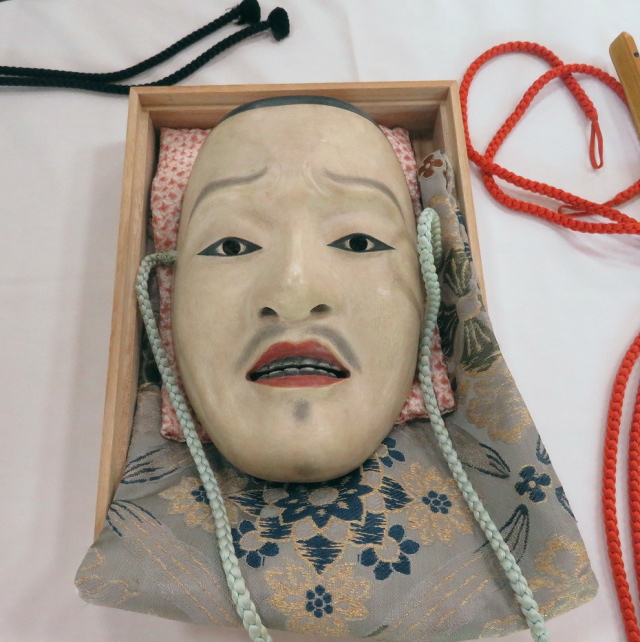
This mask is used for brave warriors in “Kachi-shura-mono” (plays featuring victorious samurai ghosts).
Bando-musha
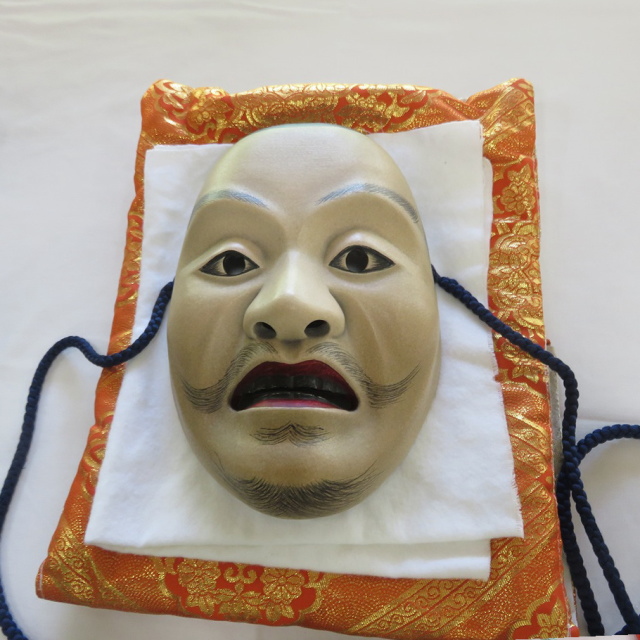
It is characterized by its slightly dark, tanned skin.
The lecturer, Mr. Ishiguro, stated, “While Kyogen highlights the performer’s character, Noh, on the contrary, is meant to erase the performer’s character.” This may mean that Noh performers, the “Shite-kata” (main actors), do not possess a desire for self-display, but instead purely face tradition and devote their lives to the art.
At first, one tends to be drawn to things that are easy to understand, but as I get older, I feel that there is also a charm in trying to understand things that are difficult to comprehend.